
I have participated in three pitching events on Twitter since I began querying my YA fantasy novel, and while I’m still in the trenches (it’s brutal out here) my last pitch event was more successful. I got nine agent likes and have three full requests out there. This is after receiving zero interactions on my first attempts at pitching, so I’m counting as a triumph. Here’s what I’ve learned, and what I’m planning to do for my fourth pitching event later this week.
Do Your Homework
1) Read the guidelines for the pitching event. Seriously. Google it and find them, because they will tell you what hashtags to use and how many times you can post. Follow the guidelines!
2) Write drafts of your pitch in a document before the day. Draft more than you think you will need, then you can use the ones you think will do better based on feedback you get throughout the day. Schedule a few, but not all of them. Adapt to the mood/vibes of the day.
3) Support other authors on Twitter on the day. This is usually through commenting or quote-retweeting, but check the guidelines. I’ve gotten some excellent feedback from other writers and made lots of new friends!
4) Images and mood boards. We love them. But most pitching events discourage the use of images because it is hard to verify that you own the rights to them. Agents have also said straight-out that they don’t look at them. The pitch is what matters. Leave the aesthetics for another day. And tag me when you post them because you know I am here for all the vibes.
The Pitch
1) Your pitch should include your character, the stakes, and what sets your story apart.
2) Try different styles of pitches. There are lots of formulas out there, and now is an opportunity to try different ones to see which resonates the most. These are a few, but there are lots more out there.
– Introduction, Inciting Incident, Stakes.
– Action-Centric: Introduction, Inciting Incident, What the character needs to do to succeed, the Problem that they will solve.
– Emoji-list. Use a list of emojis with descriptors to describe your book. (See example here)
– When-Statement. When [character] finds/discovers/learns, [catalyst or inciting incident] they must [action MC must take to to succeed] or else [what’s at stake, what the MC will lose].
3) Use appropriate comp titles. Catchy comps will get attention!
4) Don’t try and cram too much into the pitch. Focus on converting the most important plot point and its relation to the stakes or character growth. The character limit is a blessing and a curse. It will force you to get very clear on a single element of your story.
4) Pin your best tweet to your profile, and do this early. It makes it easy for others to find.
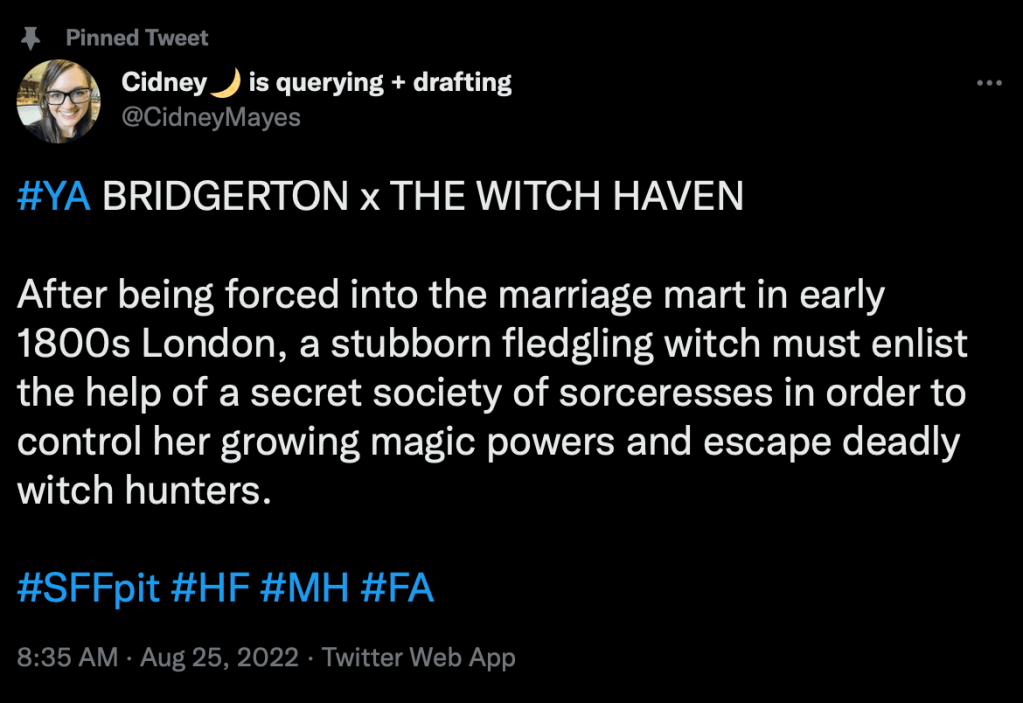
Here’s an example of my pinned tweet:
 Cidney Mayes